
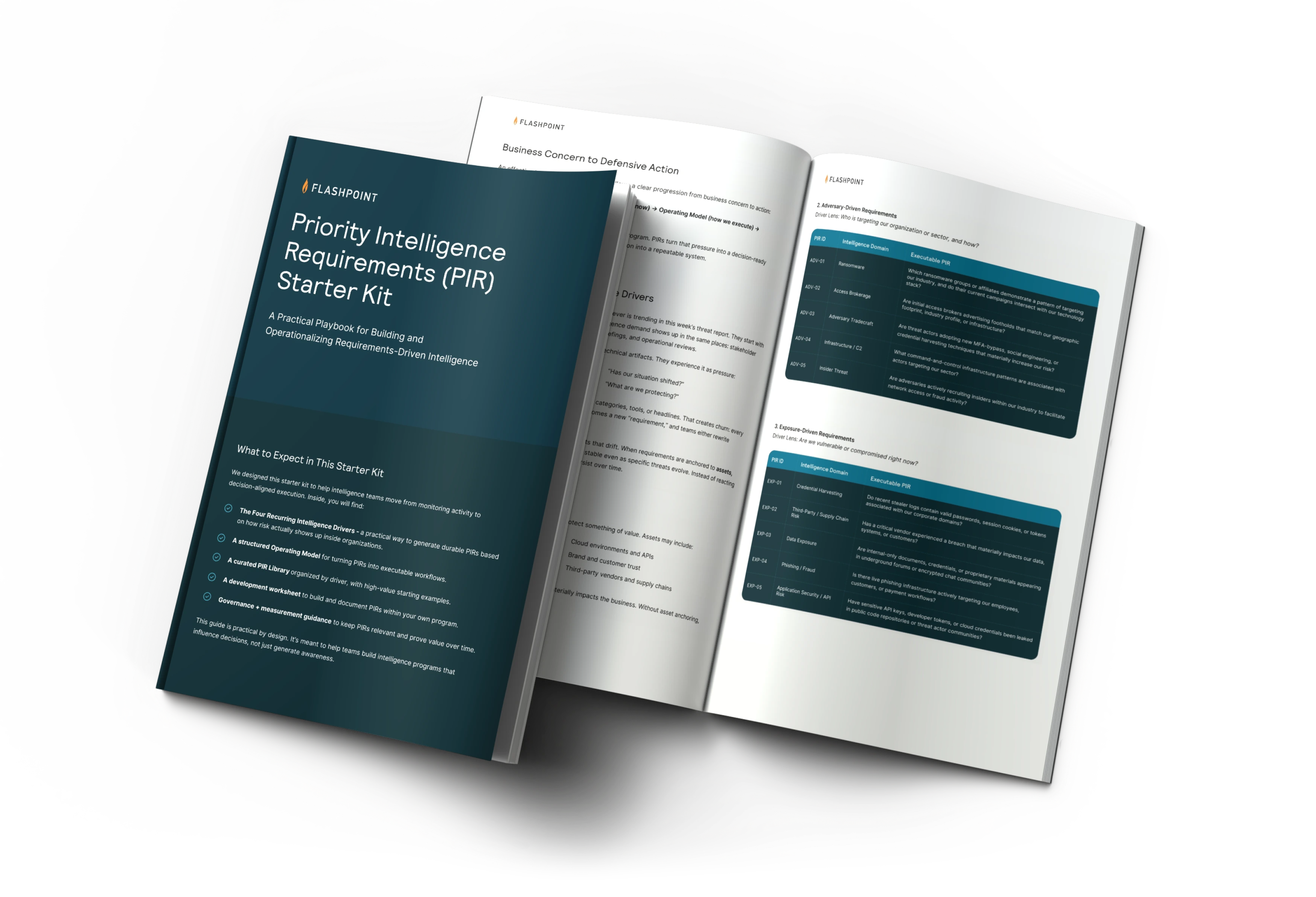
Key Takeaways:
- Intelligence must drive decisions, not just awareness: If a PIR lacks clear Decision Authority and a predefined action (e.g., force password resets, escalate to IR), it is purely informational and should be deprioritized.
- Anchor to enduring drivers, not transient threats: Structuring requirements around what you are protecting (Assets) and who is targeting you (Adversaries) prevents strategy drift and keeps your program stable even as specific tactics evolve.
- Measure success by risk reduction, not volume: The value of a threat intelligence program is proven by its ability to confirm decisions, reduce uncertainty, and prevent exploitation — not by the sheer number of alerts or intelligence reports generated.
Key Flashpoint Capabilities:
We prioritize primary-source intelligence and decisive action over generic, one-size-fits-all data feeds.
Primary Source Access
Beyond the open web. Analysts embedded in closed criminal forums and encrypted chats deliver verified intelligence before threats go public.
Vulnerability Analytics
Prioritization based on real-world exploitation — not theoretical risk — so teams know exactly what to fix first.
Operational Workflows
High-signal intelligence delivered directly into security workflows, enabling faster investigation and disruption of threats.
Gartner® does not endorse any company, vendor, product or service depicted in its publications, and
does not advise technology users to select only those vendors with the highest ratings or other
designation. Gartner® publications consist of the opinions of Gartner®’s research organization and
should not be construed as statements of fact. Gartner® disclaims all warranties, expressed or
implied, with respect to this research, including any warranties of merchantability or fitness for a
particular purpose. Gartner®, Magic Quadrant for Cyber Threat Intelligence Technologies™, Jonathan
Nunez, Carlos De Sola Caraballo, Jaime Anderson, May 4, 2026. Gartner® and Magic Quadrant are
trademarks of Gartner®, Inc., and/or its affiliates.